Skins
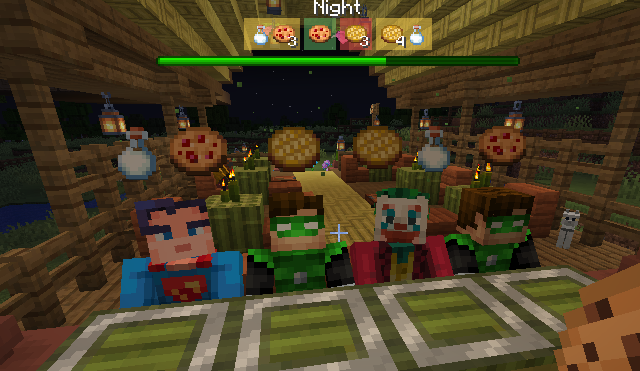
Skin packs are data-driven appearances that use standard Minecraft player skins. Each skin-pack JSON becomes a separately selectable appearance in Customer and Supplier Spawner interfaces. When a skin-pack appearance is selected for a villager, its saved appearance variation consistently selects one of the skins in that pack.
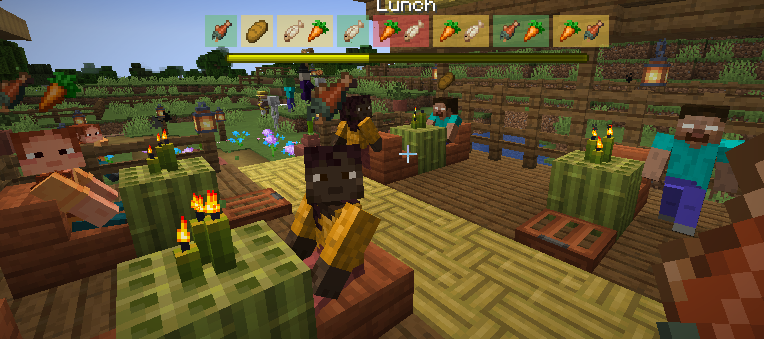
The mod includes an MC Skins appearance containing Alex, Ari, Efe, Herobrine, Makena, Steve, and Zuri.
A skin pack uses synchronized data-pack definitions together with client resource-pack textures and optional sounds:
When distributing a skin pack as one combined ZIP, install it in the world’s datapacks
folder for the skin definitions and in the client’s resourcepacks folder for its
textures and sounds. Enable the resource-pack copy from Minecraft’s Resource Packs menu.
data/{namespace}/customers/skin_packs/{pack}.json
data/{namespace}/customers/skins/{skin}.json

assets/{namespace}/textures/customers/skins/{texture}.png
assets/{namespace}/textures/customers/skins/{texture}.png.mcmeta

assets/{namespace}/sounds/customers/skins/{sound}.ogg
assets/{namespace}/sounds.json
For example, this file defines an appearance named Example Skins:
data/example/customers/skin_packs/example.json:
{
  "name": "Example Skins",
  "skins": [
    "example:steve",
    "example:alex"
  ]
}
Each referenced skin has its own definition. Steve uses the standard wide-arm player model:
data/example/customers/skins/steve.json:
{
  "texture": "example:steve",
  "model": "wide"
}
Alex uses the slim-arm player model and demonstrates the optional rendering and sound settings:
data/example/customers/skins/alex.json:
{
  "texture": "example:alex",
  "model": "slim",
  "scale": 0.9375,
  "shadow_radius": 0.5,
  "name_tag_offset": 0.0,
  "sounds": {
    "ambient": "example:alex_ambient",
    "hurt": "example:alex_hurt",
    "death": "example:alex_death",
    "step": "example:alex_step",
    "yes": "example:alex_yes",
    "no": "example:alex_no"
  }
}
The texture IDs in those definitions resolve to:
assets/example/textures/customers/skins/steve.png
assets/example/textures/customers/skins/alex.png
Standard .png.mcmeta files can animate modern 64×64 skins. A legacy 64×32 skin can
set "legacy": true; legacy skins are converted at runtime and cannot be animated.
Every sound is optional. A missing sound uses the normal Villager sound for that action.
Custom sounds use Minecraft’s standard sounds.json system. For example:
assets/example/sounds.json:
{
  "alex_ambient": {
    "sounds": [
      "example:customers/skins/alex_ambient"
    ]
  },
  "alex_hurt": {
    "sounds": [
      "example:customers/skins/alex_hurt"
    ]
  },
  "alex_no": {
    "sounds": [
      "example:customers/skins/alex_no"
    ]
  },
  "alex_death": {
    "sounds": [
      "example:customers/skins/alex_death"
    ]
  },
  "alex_step": {
    "sounds": [
      "example:customers/skins/alex_step"
    ]
  },
  "alex_yes": {
    "sounds": [
      "example:customers/skins/alex_yes"
    ]
  }
}
Those entries load OGG files from:
assets/example/sounds/customers/skins/alex_ambient.ogg
assets/example/sounds/customers/skins/alex_hurt.ogg
assets/example/sounds/customers/skins/alex_death.ogg
assets/example/sounds/customers/skins/alex_step.ogg
assets/example/sounds/customers/skins/alex_yes.ogg
assets/example/sounds/customers/skins/alex_no.ogg
Sound definitions may use normal Minecraft sounds.json features such as multiple
weighted variants, volume, pitch, subtitles, streaming, and replacement. Skin packs
with IDs that conflict with code-defined appearances are ignored in favor of the
code-defined appearance.